
Kotodama Yokai Juku
Kotodama Yokai Juku is a pixel art roguelite for iPhone that teaches players to read every JLPT kanji, from N5 to N1, by fighting the yokai of Japanese folklore. It is an independent game, designed and developed end to end: the game design, the learning system, the pixel art, the music and the app itself.
- Role
- Game design, art & development
- Platform
- iPhone
- Stack
- Swift 6, SwiftUI
- Timeline
- Aug 2026 – today
Context
Kotodama is the old Japanese belief that a spirit lives in words. In this game the yokai live in them too, and the only way to beat one is to read it.
Most kanji apps ask for effort before anything happens: open the lesson, then start studying. Here a player picks a place on the map, rolls a die or walks into a dungeon, and the reading happens along the way. Over the whole game that adds up to all 2,341 kanji of the JLPT, learned through more than 16,000 real words.

Every attack is a question
Battles are turn based, and every attack is a question. The player reads a real Japanese word and picks its reading, builds the word from tiles, or types it in kana. A right answer strikes, and a miss lets the yokai strike back.
New kanji arrive one word at a time, each on a card of its own, and missed words return until they stick. No reading is shown over a word before it is answered, so it has to come from memory. Stars on every word rise with spaced right answers and drop with a miss.
Three ways to play
Every place on the map can be played in three ways. Sugoroku is a board game with a die. Adventure is a branching map of battles, shops and inns. Naraku is a dungeon walked one step at a time, with the yokai moving after the hero.
Each mode keeps its own run and hero, while the learning is shared, so every word read in one counts in the others. Runs are roguelite: chests may bite, stone statues ask a question with the stakes shown first, and a fallen hero loses the level, gold and gear of that run. The stars of every word, the books and the heroes who joined stay.
A map of Japan
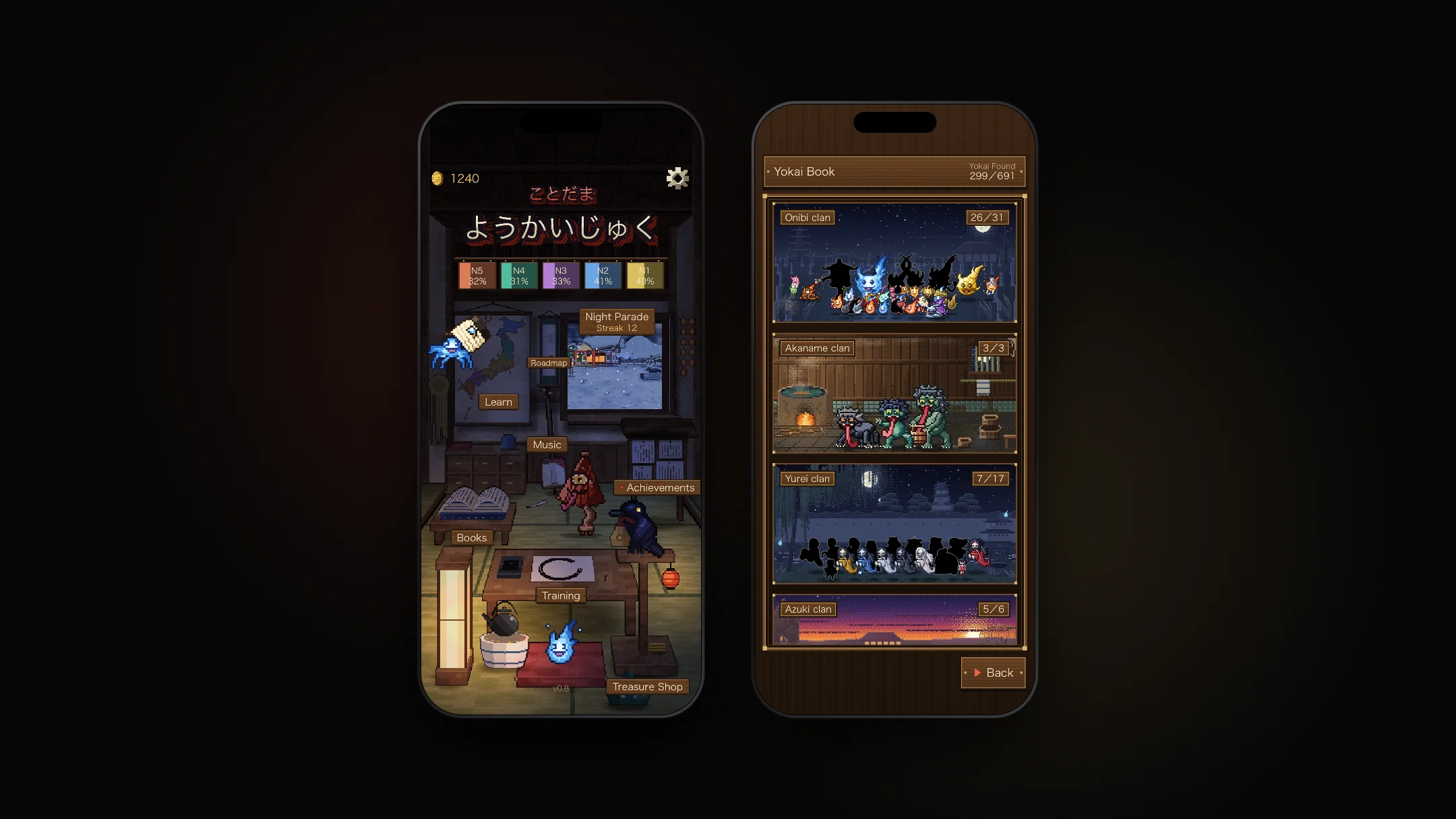
The game is set on a pixel map of Japan with 63 real places, each a lantern on the map. The JLPT levels are laid over the country: N5 begins in Kyushu and Okinawa, N4 runs through Tohoku, N3 covers Chugoku and Shikoku, N2 is Hokkaido, and N1 sits in the middle, from Tokyo to Kyoto. Mount Fuji comes last, and every kanji comes back there.
Every place runs on its own clock and on real weather from the Japan Meteorological Agency. When it rains in Kyoto, it rains in a Kyoto battle, and snow lies on the board in a Sapporo winter. Offline, each place replays weather from its own past, so the game plays on.
Yokai that keep to their legends
Close to 700 yokai fill the Yokai Book, each drawn from Japanese folklore and written up from its tale. More than a hundred live where their story comes from, and many appear only at their own hour, weather or season: the yuki-onna comes only on winter nights, in the snow country of Tohoku, Niigata and Nagano.
For every yokai still missing, the book gives a hint of where and when to look, so a rainy night becomes a reason to go out hunting.
Every yokai moves
Each yokai is drawn as a full set of animations: an idle loop, an entrance, an attack that lunges at the hero, a flinch when hit and a death. A second, isometric sheet idles and walks the boards and the floors of Naraku in every direction, hopping, gliding or stomping the way its body would.
Heroes with two souls
Heroes join along the way, each with strengths of their own. Every hero has two souls: a calm one that keeps them balanced, and a wild one that pushes a few strengths to the extreme and gives up the rest.
The soul can only change outside battle, and in Naraku the change costs a step, so picking the right soul for the next fight is part of the plan. Each hero turns in a way of their own: frost that shatters, a flock of crows, a shadow that swallows its owner, a fox fire, a wolf.
Hyakki Yako, the night parade
Once a day, a parade of 100 yokai comes through one place at night, row after row, with the next rows waiting further up the road. Every yokai falls to one right answer, and about ten misses end the parade.
Playing it to the end every day keeps a streak going. A reminder can come at a chosen hour, and a home screen widget shows the streak and tonight's lead yokai.
For Japanese players too
Kanji apps are almost always made for learners abroad. In Japanese, the whole game is written in kana with the English hidden, so the only kanji on screen are the ones being learned. A child can learn the 1,026 kanji of elementary school this way, and an adult can sharpen their reading or win back the kanji they forgot.
In English, the menus are English while the questions stay Japanese, with a word's meaning shown until it is well known. Players who cannot read kana yet can start on a kana island first.
Visual identity
The look is lacquer and wood, taken from an old Japanese room: dark windows in wooden frames with brass corners, titles on wooden plaques, cream text, gold headings and a single vermilion for the cursor and the main command.
The pixel art moves in whole pixels and is never smoothed, while all text is set in Hiragino Sans, so the kanji stay sharp and readable at every size. The soundtrack is the game's own as well, with more than a hundred songs, from the title theme to a set for every event island.
Technical setup
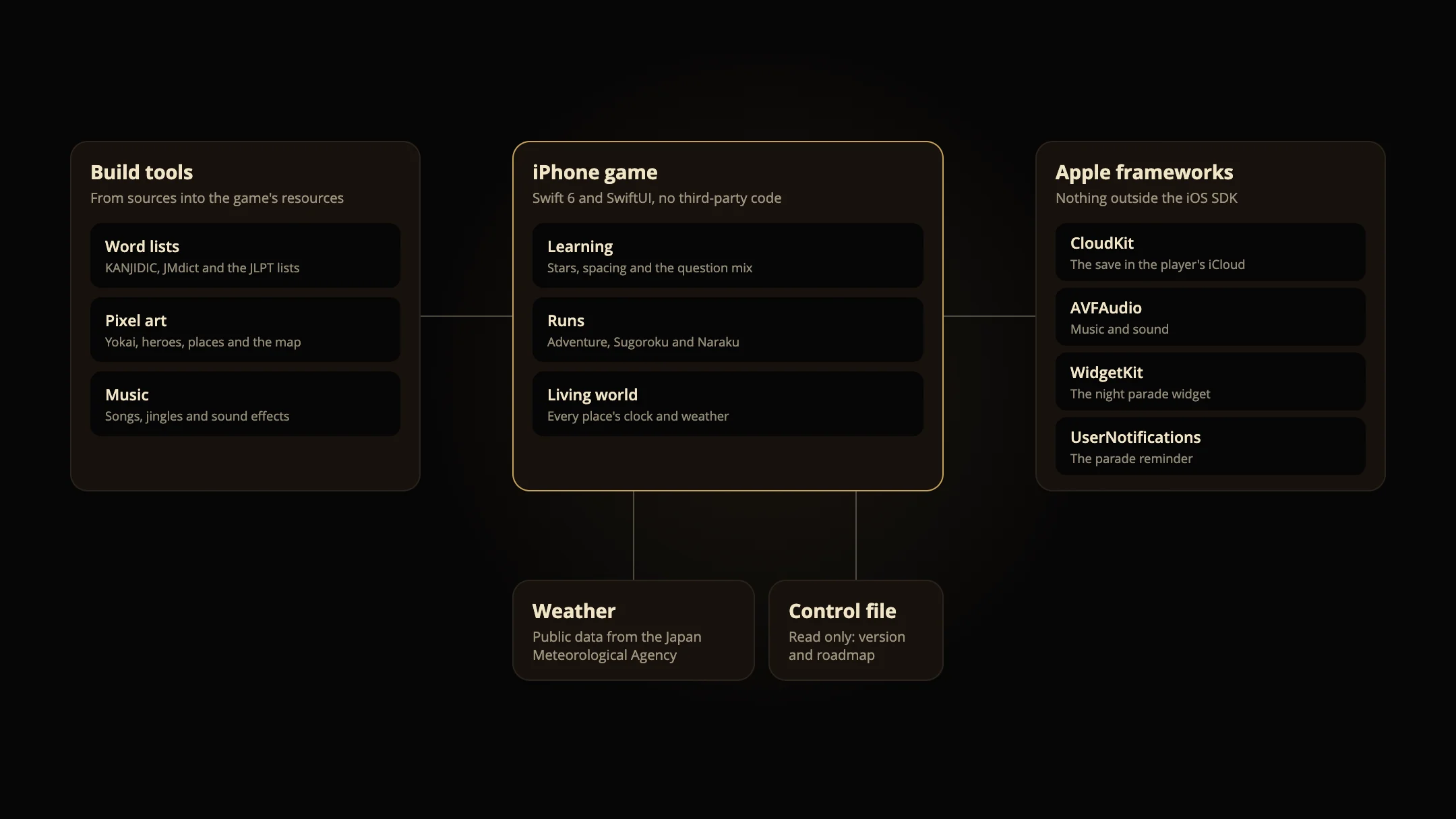
The game is written in Swift 6 with SwiftUI on every screen, and uses only Apple's own frameworks: CloudKit keeps the save in the player's own iCloud, AVFAudio plays the music, WidgetKit draws the parade widget and UserNotifications sends its reminder. There is no third-party library or SDK, no ads, no account and no tracking.
The game reads two things from the network: the public weather, and a small read-only file with the minimum version and the roadmap. Everything else ships inside the app, built by tools that turn open dictionaries into the word lists and build the pixel art and music into the game's resources.
Outcome
Every region from N5 to N1 is built and playable on iPhone, with all three modes, the night parade and the event islands. The game has not been released yet.
 Kotodama Yokai JukuComing to iPhone